

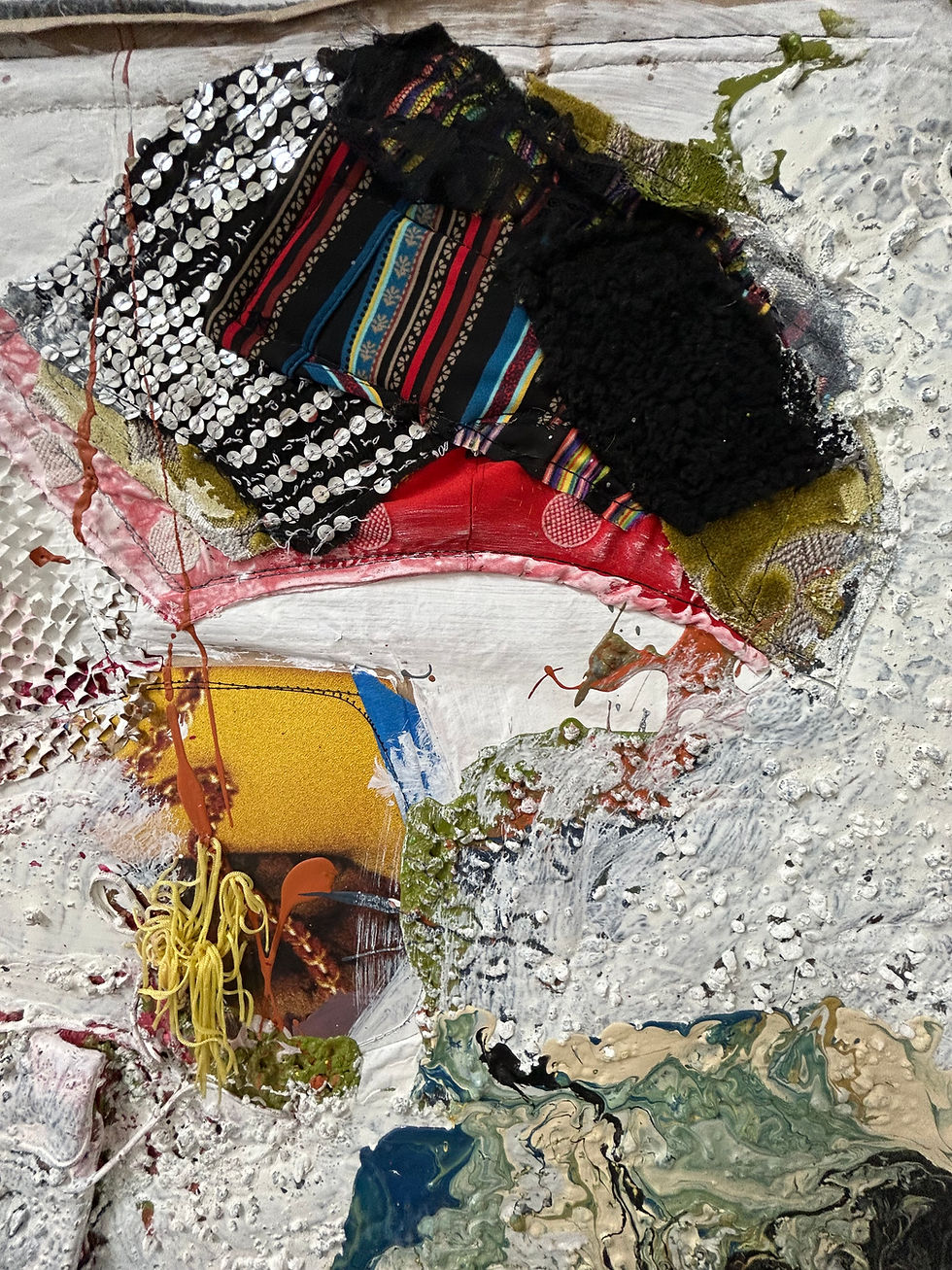
In Conversation with Alan Neider
When I approach an artist, I always feel a mix of admiration, honor, and respect. This is certainly the case in my recent conversation with the legendary eighty-one-year-old Alan Neider. He is an heir to the great American Pop era, shaped by the American dream, and I feel humbled by the privilege of speaking with him. His life touches the names, places, and moments that shaped the American art world; his voice carries the memories of someone who was there, who witnessed it, and who is continuing it every day.
Our conversation didn’t take place across a table or by a cozy hearth. We met online, across the Atlantic Ocean — Alan Neider in Hamden, Connecticut, and me in Ostend, Belgium. It was a long-distance exchange between continents, generations, and art worlds.
Normally, I keep interviews short and to the point — I kill my darlings. But in this warm, generous exchange, I couldn’t cut a single line: every recollection, every nuance, every gently or sharply delivered insight needed its place. At moments, it felt as if I were speaking with a friend, a teacher, a kind of painter-shaman I’d known for years — a solitary, seasoned artist with nothing to hide and everything deeply lived.
What follows is an encounter that pulls you into famous galleries, studios, eras, and lives that continue to resonate. To me, it felt like America was great again.
Thanks so much for taking the time to talk with me. To start us off, could you walk me through the key artistic steps in your long career? What were the highlights — the turning points? How did you become the artist you are today?
Alan Neider: Everything about my artistic background—really everything about me as a creative person—comes from my grandparents. My grandfather was a tailor, always sewing, always surrounded by fabric and thread. And now, decades later, I find myself sewing too. I’ve actually been sewing since the mid-seventies.
My grandmother, on the other hand, loved those old “paint-by-number” kits. You know, where each little shape has a number and each number stands for a color. I used to sit beside her as a kid, watching her fill in those shapes. Eventually she let me paint my own. I loved it—the smell of the oil paint, mixing the colors, the feeling that something was slowly revealing itself under your hands.
So, if you take my grandfather’s sewing and my grandmother’s painting, you pretty much get me. And there’s a third element too: my grandmother was also an avid gardener. I garden now as well, and have, for a very long time. Those three things—sewing, painting, gardening—are the foundation of everything I do creatively, and they all trace back to my grandparents.
Everything good in me, everything creative and generous or productive—that’s all them. Not my parents. That’s a big statement to open with, I know.
My parents were focused on earning money. They ran grocery stores and meat markets and wanted me to follow in their footsteps. I really didn’t want that. I did work in the store for a while, and I hated every minute of it. I rejected all of it, absolutely. And eventually…
Well, in high school, the one thing I truly loved was art class. Then I went to junior college, and that’s where I really blossomed. The teachers were wonderful, the environment was supportive—it felt like someone finally turned the lights on for me. Even though I eventually earned a master’s degree in sculpture, junior college was the true highlight of my education. I went from this dull, unsure kid to someone who was fully alive. I stayed up all night working on projects, I got A’s, I pushed myself. That’s where everything started
So, finally your parents did support you in this?
Oh, definitely not. My parents had no interest in me becoming an artist—they didn’t pay for anything, not a single thing. They were opposed to pretty much everything I stood for. It felt like a constant tug-of-war. I mean, we clashed so often that it was exhausting. I finally moved out, but honestly, I wish I’d done it much earlier.
But you kept your real name, the one your parents gave you. Have you ever thought about adopting an artist name? And if you did, what name would you choose?
You know, that’s a question I’ve honestly never thought about. It never even crossed my mind. I carry my father’s name, but it’s also my grandfather’s family name—his name was Alex Neider. I even named my daughter Alexis after him. He was someone I dearly loved, and I love my daughter just as much, so it felt like a way to honor both.
And so, there’s Alex Neider, me Alan Neider, and Alexis Neider. I think, though I’m not 100% sure, that the name ‘Neider’ was shortened when my grandfather came through Ellis Island. I don’t know what it was shortened from, but a lot of names were simplified back then. In the end, it doesn’t really matter. It’s the people behind the name that count.
Your next exhibition takes place at the Micki Chomicki Gallery in Antwerp, Belgium, a gallery celebrated for its dedication to fiber and textile art. How does your work fit into this unique approach?
Honestly, without wanting to brag, it just sort of fits. Back in the mid-seventies, I started using fabrics in my work—not as materials, but as paint. I used the textures, patterns, weight, and color of fabrics, in the same way a painter uses pigment. When I’m choosing fabrics—oh, I have a huge pile, and I’m always collecting more—people send me scraps, I find them in thrift shops, I buy them. To me, picking the right fabric is exactly like mixing paint. It’s just another way of painting.
I’ve been painting for a long time. When I was in Chicago, I made these enormous squeegee paintings on floors. Some were twenty feet wide by six feet high. We had this big building with a basement workshop where I built the stretchers. (Laughs) Some were so big; they didn’t even fit through the door! Eventually, I wanted a complete change—everything about the way I painted. I moved from floor to walls, from acrylic squeegee paintings to oil staining, from canvas to fabrics, and from pure abstraction to… well, that’s when the curtains came in.
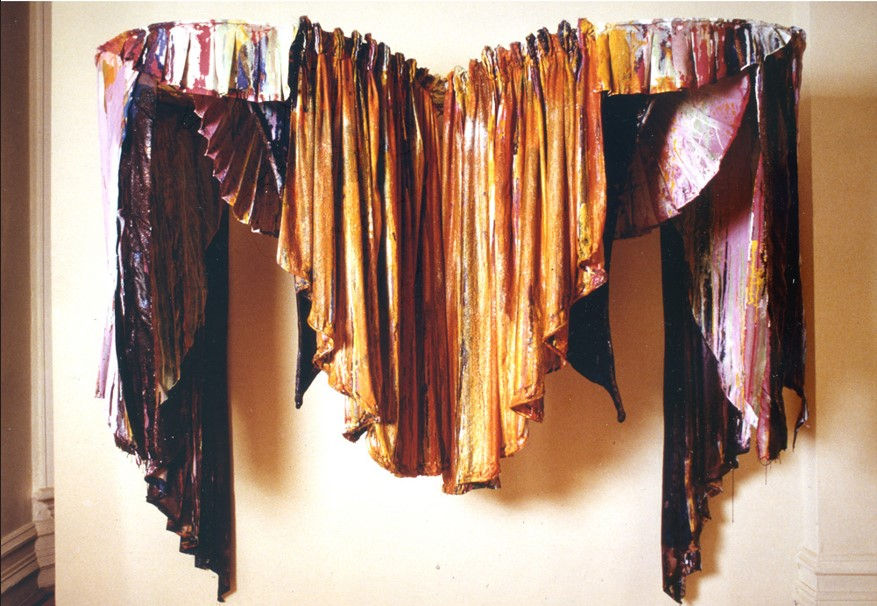
I started making curtain paintings for about four years. Why curtains? Because curtains frame windows, and windows are often how we see the world. So, the curtains weren’t just objects—they were paintings acting as visual supports for our perception of the world. Some were huge, six, seven, eight feet wide, flat at first. Over time they became three-dimensional. I would build steel superstructures and hang the fabrics, then layer the stains with turpentine washes—loose, dripping layers, over and over.
My very first show was in Washington, D.C., at the Henri Gallery, around 1973 or 1974. I was only a couple years out of grad school. It was a solo show, and Henrietta Springer Ehrsam, the founder, sold quite a few pieces. I was like, “Oh my god!” I couldn’t believe it. And yes, those were the curtain paintings.
The last show I did with the curtains was at the Nancy Lurie Gallery in Chicago, in 1980. At that time, it was the hottest gallery in the city, and I had a solo show featuring the final set of my curtain works. These were the three-dimensional ones—some of the curtains came off the wall, about three feet out. You could actually walk into them. It was something unique.
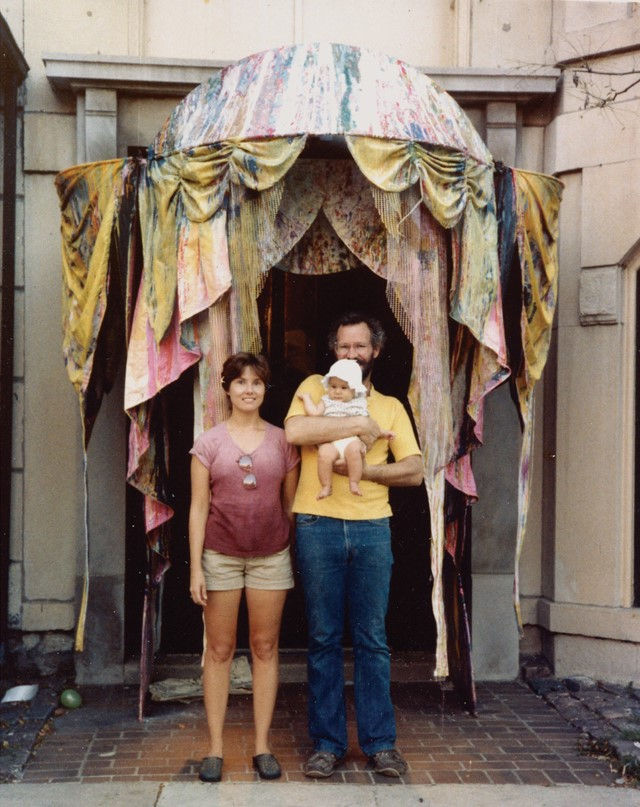
For the show, I even made an awning outside the gallery—14 feet high, about 8 feet wide, 10 feet deep. So, if you wanted to see the exhibition, you literally had to walk through the awning to get into the gallery. Pretty audacious, I’d say.
Back in the seventies, I was doing this before anyone really thought about textiles as a big part of art. Nowadays, people are using textiles all over, and that’s great. But for me, it was just about adding fabric to paintings, a way to explore painting itself—a kind of subversive investigation into the nature of art. It wasn’t about saying, “I’m going to be a textile artist.” I wasn’t even aware that textile art would become such a thing later.
So, I always put this in my artist statements, that from that point on, in the seventies, I didn’t stop using fabrics and textiles in one way or another, in my art. It continues today, like for example I just finished a series called exotic plant life. They’re paintings of exotic plants, but they’re quite abstract and I have incorporated fabrics on the front of these paintings, which are on paper, and on the back.
I see. So, you live in Hamden now, just outside New Haven, right? That’s not too far from New York. I’m curious—how much does the New York art scene influence your work today? Or was it more important back in the ’50s and ’60s when you were really finding your footing as an artist?
You’re right—Hamden is just a few miles from New Haven, which is bigger and where Yale is. Yale has some fantastic galleries, including the British Art Gallery, but honestly, there’s not a whole lot in New Haven itself for artists.
So, do you look outside, then, to places like New York or upstate New York for inspiration?
Exactly. Upstate New York, the Hudson Valley in particular, has a lot going on. I’m trying to make inroads with galleries and connect with other artists there. So, it doesn’t fully answer your question about New York itself, but that’s part of what I’m doing now.
Back in the fifties and sixties, though, I wasn’t active in New York. I was in school then. But there were other influences that shaped me. One of the most eye-opening experiences came through a friend from grad school: John. After graduating, he got a studio in a big barn in Washington D.C., and somehow Sam Gilliam ended up sharing that space with him. Sam was already a prominent artist. Sam Gilliam was of course a very high-powered artist.
That must have been exciting!
Oh, absolutely. Sam was on the third floor, my friend John on the second, and Rockne Krebs, who was doing fascinating laser work, on the first floor. When Sam was away, John let me see Sam’s studio. The sheer scale of his production was mind-blowing—big rolls of canvas and gallons of paint coming in one end, finished work coming out the other. I’d never seen anything like it.
Another big influence was a grant I received while at Washington University in St. Louis—the Robert Rauschenberg Change, Inc. Work Grant. It was $500 in 1971, which was huge for a student. He even sent a letter on portrait paper explaining the delay in sending the check. That support allowed me to finish my thesis and was incredibly motivating.
Wow, receiving that directly from Rauschenberg must have been overwhelming. Did it shape your work?
It did, though it took me years to find my own voice after that. You’re always influenced by someone early on—you can trace lines through people’s work—but eventually you have to step out, and define your own vision. Some artists never manage it, but I eventually did.
We did go to New York as often as we could, even then. Now, living in Hamden, it’s about an hour and a half depending on traffic. We visit galleries in Soho, TriBeCa, and the Upper East Side, sometimes spending a whole day hopping from gallery to gallery, having lunch in between, and visiting big shows at the Met or MoMA. For example, Rashid Johnson is showing at the Guggenheim right now—one of my favorite artists—but I haven’t seen it yet.
And you actually met Rauschenberg himself?
(laughs) Yes! Many years ago, walking down Hollywood Boulevard with my first wife, I ran into him and my old friend Jim Webb, who became a master printer at Gemini. We ended up at Jim’s apartment, had a few drinks—Jack Daniels, of course—and I remember I gave Jim Webb a sculpture as a wedding present. Rauschenberg commented on it, which was amazing. I was over the moon!
It sounds like you’ve had some incredible moments like that.
Oh, definitely. Those encounters, those early experiences—they stay with you. (laughs) Alright, give me more questions!
Of course. We were talking about the famous Gemini G.E.L. workshop and the Pop-art influences that inspired—and sometimes challenged—you, with names like Robert Rauschenberg, Larry Bell, and Sam Gilliam. I know today, you work in series, but earlier in your career, did you ever explore printmaking? Did you create editions or multiples, a practice that was popular back in the sixties, seventies, and beyond? Did you make etchings, lithographs, or engravings, for example?
Yes, absolutely. When I was an undergrad at Long Beach State in California, they opened a lithography department within the printmaking program. The instructor—he came from Canada, if I remember correctly—was incredibly professional. He set a really high standard, and I loved it. Drawing directly on the stone was quite something—so beautiful, so immediate.
It turned out that a number of us learned lithography quite well. Jim Webb, whom I mentioned earlier, went straight from that program to Gemini.
That’s amazing—so that program really had far-reaching influence.
Exactly. And here’s another Rauschenberg connection: there was a guy named Bob in that department, tall and handsome, who ended up in Florida working closely with Rauschenberg and being his lover. So, in a way, that printmaking program in California had a direct line to Rauschenberg’s creative center on Captiva Island. A lot of things sprang from that department.
And what about your own work—did you make multiples?
Yes, I made multiple lithographs. But I didn’t enjoy printmaking with plates, zinc, and etching so much—it felt too mechanical. But lithography? I loved it. It’s much closer to drawing, much more immediate, and that really resonated with me.
Shifting gears a bit—having had such a rich and accomplished career, you’ve seen many political eras. Art often reflects society, and themes of power and politics have always been part of artistic expression. Today, the U.S. feels deeply divided, and the new geopolitical climate is both fascinating and, for some, unsettling. How does this influence your work? Do you confront these realities in your art, or do you tend to step away from them?
Oh, I’m definitely aware of what’s going on. We get the New York Times delivered every day and watch PBS NewsHour. We don’t really follow CBS or any of the other programs. So, we know what’s happening. But honestly, sometimes it’s just overwhelming, and you kind of block it out. It’s too much.
I mean… Trump has become… well, it’s hard to describe. He’s almost a deity, more than just a politician. He’s molded himself beyond anyone else, even Putin in a way. It’s astonishing—he’s getting away with so much, and no one seems able to stop him. His influence isn’t just here in the U.S., it’s global.
Does it influence me personally? Sure. As a political person, as a citizen, as a voter… absolutely.
and as an artist?
As an artist, I don’t really see it coming into my work. I don’t paint about it. I couldn’t, I just don’t… It doesn’t feel right.
Take 9/11, for example. I remember seeing artists trying to interpret it through paintings or other media, online and elsewhere. For me, it felt… feeble. The event was just too enormous. I couldn’t even attempt it.
But then, recently, I saw a retrospective of Jack Whitten at MoMA. He did this massive painting called 9.11.01, which was directly influenced by the World Trade Center bombing. His studio was right near the Towers—he saw the planes hit, and years later, he watched the new towers rise. That experience stayed with him, and the painting was incredibly powerful. It made me realize that, yes, an artist can respond to tragedy in a meaningful way. But me? I will never attempt that. It’s just beyond me.
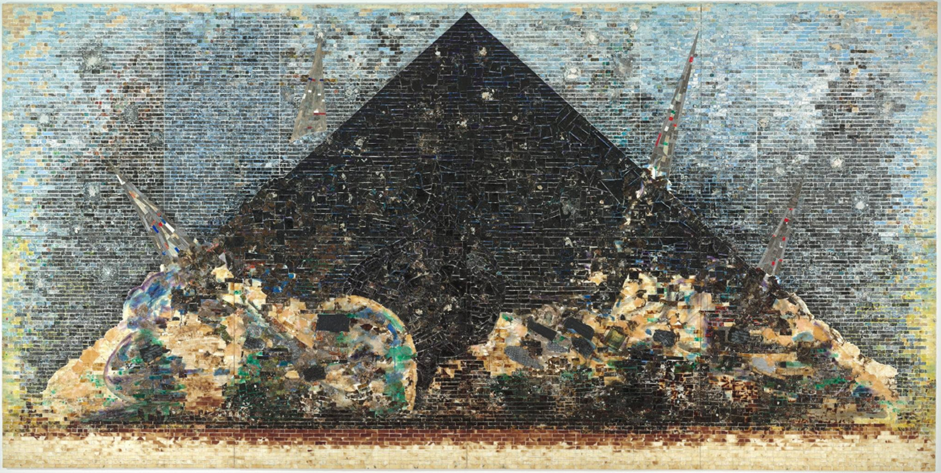
Many artists are influenced by movements or try to position themselves in relation to other trends. How do you see your own work in that context? Are you reacting to other movements, or are you following a more personal path?
I’m not trying to rebel against any other movement. That’s just not me, and I’m not interested in it. What I am interested in is following my own line of thinking, my true path. There’s a kind of continuum in my work—from one group of pieces to the next—and they all influence each other. Seeing that growth and development, that’s what really fascinates me.
The other thing that drives me is the push. When I’m in the studio, I need to feel that I’m really challenging myself. If I’m too comfortable, if I look at my work and think, “Oh, this is nice… this is good,” then I know I’m doing it wrong. That feeling of satisfaction? That’s a warning sign. I know that’s negative. If I’m feeling that way I know: “Alan, you’re wrong”.
I want to be dis-satisfied, I want to be upset, I want to be uncomfortable. I want to wake up in the morning, turn on the lights, and think, “what the fuck is this shit, you know, this is crazy, this is fucked up”. That’s exactly what I’m looking for.
I don’t want to feel satisfied. That’s my main interest. That’s the whole point for me.
Your work is a complete self-examination.
Well yeah, I mean, I am totally interested in other artists, I look at art all the time, like I said, I go to New York a lot, to look at galleries, to look at other artists, to see what people are doing. There are lot of other artists that I look at, and I have a lot of favorite artists. I can name them, but that doesn’t matter, I mean I’m just inspired by lots of different artists. I love seeing what they’re doing.

These days, some people say that art is going through a crisis. How do you see what’s happening in the art world right now? Do you see it as a crisis, or perhaps as a turning point?
Hmm, that’s a really good question. I’m not sure I’d call it a crisis. There are definitely profound leaders in the art world right now doing remarkable things, really setting the pace.
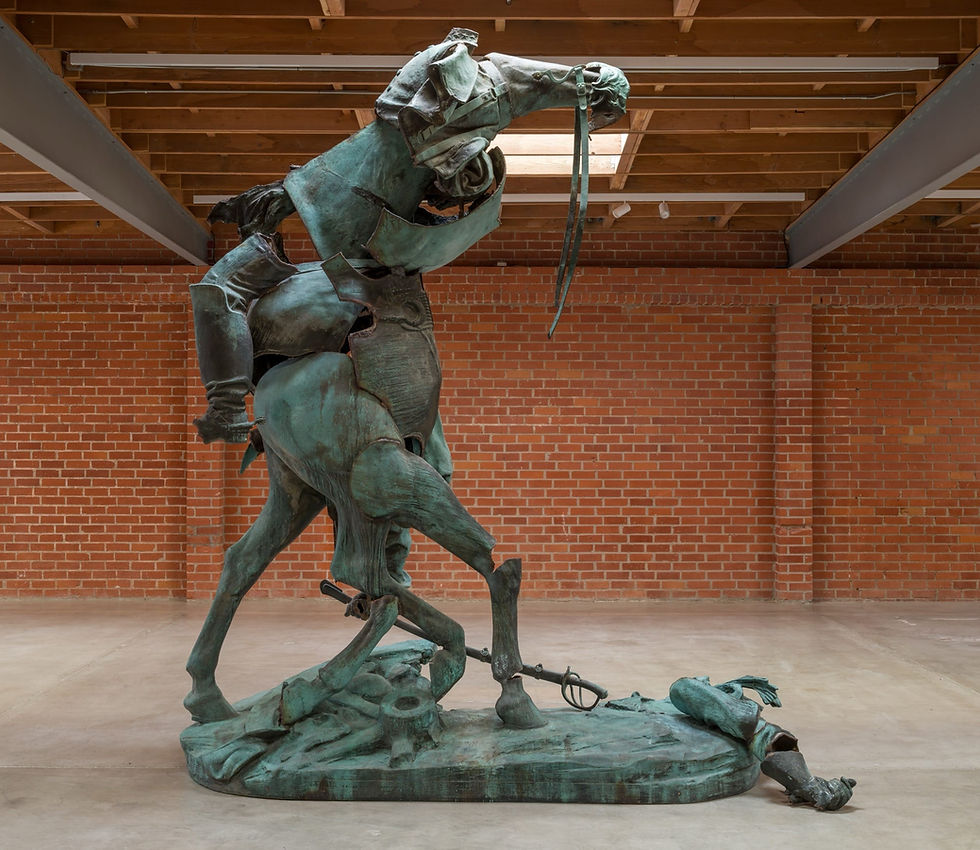
For example, just today on the front page of the New York Times, there’s an article about a show at the Geffen Contemporary at MOCA in Los Angeles. The work that really caught my eye was Kara Walker’s. She’s been taking sculptures from the Lee Monument that were torn down and abandoned—you know, the statues of Robert E. Lee in the South—and for years she’s been cutting them up, reassembling them into collages, reinterpreting the figures and horses in new ways. I think that’s amazing. She’s making a profound statement about racism and decolonization, and she’s really leading the conversation.
How much this will influence other artists? I don’t know yet, but it certainly will. Years ago, she did a piece called The Marvelous Sugar Baby—an enormous white sugar sculpture of a mammy on her knees, installed in the abandoned Domino Sugar Factory in Brooklyn. Seeing it in person was overwhelming. It left a huge impression on me. Kara Walker is a true leading artist, and her work reminds me that the art world is constantly being pushed forward, even in challenging times.
But in your artwork, it feels like you’re moving away from politics. Would you say that’s true? Almost like an escape into another world—a world of color and freedom. It seems like your work offers a kind of refuge from all the political turmoil around us.
(laughs) No, I’m not on that level. I don’t want to be the one with all the answers. I’m not sure I can really help with that. I don’t have anything to say about politics in my art. Sure, I could shout, “Fuck Trump!”—but what does that really do? I could march; I was a conscientious objector during the Vietnam War. I did two years of service, protested everything.
But right now, my thoughts about politics… I just don’t bring them into my work. I don’t know how I would even manifest that in my art, and honestly, who cares?
My focus is on painting. My focus is on weaving together the ideas I’ve been exploring, a through-line I’ve been following for decades.
You know, take Brice Marden for example. I don’t think his work is political, but it’s just beautiful. Gorgeous, really. And that’s what we need—beauty in a world that’s often ugly. Not politics. We need that, absolutely.
Over the years, you’ve met and been inspired by many artists. Are there any recent encounters that have left a strong impression on you or reminded you why art is such an important part of your life?
Oh, absolutely. Fascinated by the work and the world of artists today, I recently had the chance to meet Ibrahim Mahama. I brought a book for him to sign, and getting to talk with him was really something. He’s someone who has influenced me a lot, over the years. I loved asking him questions and hearing his thoughts.
It turns out he was just awarded the first annual Sam Gilliam Award—$75,000—at Dia Beacon in Chelsea. He also gave a lecture on his art, which was fascinating. He was so gracious and open. Honestly, it was one of the true thrills of my lifetime.
Moments like that remind me that art is my entire life. Meeting artists like him, seeing their work and hearing their ideas—it’s so important. That encounter was one of the highlights of my life.

ALAN NEIDER
RETROSPECTIVE
MICKI CHOMICKI GALLERY
November 29 - January 17
2025
